What Are RevOps Leaders Building with AI? Part I
Earlier this month, 85 revenue operations leaders from the world’s leading technology companies convened at “Vector,” an invite-only summit in Mountain View, California. The event objective was to give the people who run the commercial machinery of technology companies a private setting in which to compare notes on how artificial intelligence is changing their work.
For readers outside the field, revenue operations (RevOps) is the function responsible for the systems, data and processes behind a company's go-to-market (GTM) effort: how prospective customers are routed to salespeople, how territories and quotas are set, how revenue is forecast, and which software the sales, marketing and customer success teams use. Because RevOps leaders control a large share of GTM software budgets and see operating results firsthand, they are an unusually useful early indicator of where enterprise software spending, and the companies that depend on it, are headed.
Part of the day was eight closed-door roundtables, which we recorded with participants' permission. We transcribed each session and catalogued every concrete example an attendee gave of something their team had built, deployed or piloted. The result is a set of roughly 100 builds: AI agents, internal applications, data infrastructure and new ways of organizing teams. We excluded aspirations and vendor demonstrations; what remains are tools in use, most with reported results.
This piece has two parts. Part 1 sets out the principal conclusions we draw from the sessions and what they may mean for founders and operators. Part 2 presents a detailed view of the key builds that RevOps leaders are working on and how to think about prioritization on your roadmap.
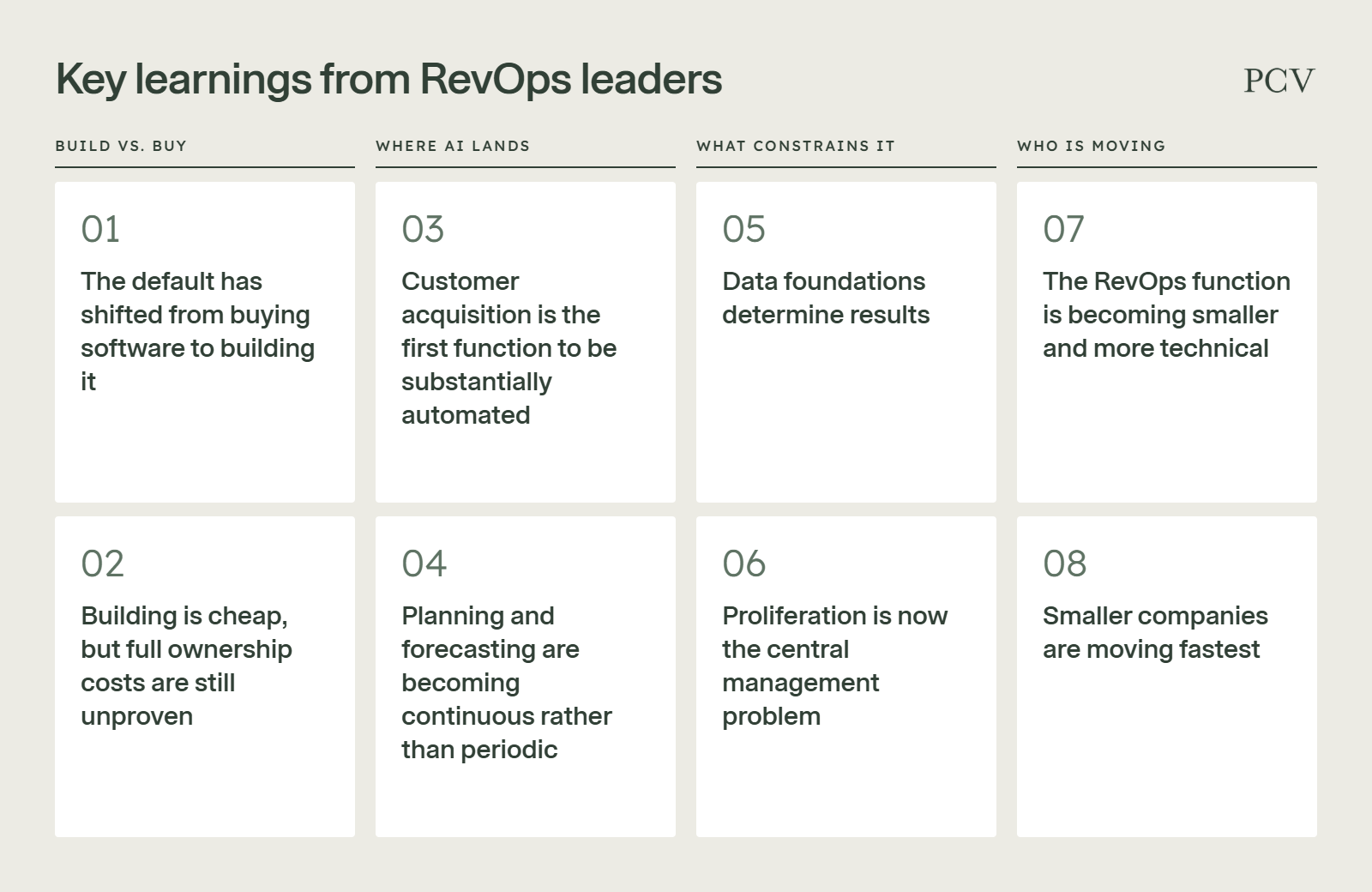
Part 1: What We Learned
We draw eight conclusions from the sessions, followed by some tentative implications for investors.
Shift from buying software to building it.
The most consistent theme across all eight sessions was a shift from purchasing software to building it. Because AI coding tools have sharply reduced the cost of writing internal applications, many tools that were once too expensive to justify building are now cheaper to build than to license. One large enterprise has made this an explicit policy: it never buys a GTM tool priced between $5,000 and $25,000 a year and rarely buys one priced up to $100,000. Its internal forecasting application cost roughly $800 to build; the product it displaced had cost the same leader $120,000 a year at a previous company. The shift now reaches the system of record itself. Three large enterprises have replaced, are replacing or plan to replace Salesforce, and one completed its move to an in-house customer relationship management (CRM) system in six months.
Building is cheap but full ownership costs are unproven.
The room was not unanimous, and the counterexamples are instructive. Building is inexpensive; maintenance, integration and governance are not. One mid-size company spent six to nine months having engineers build GTM agents under a chief executive's mandate and could identify no measurable improvement in sales productivity; its leader concluded the company "could have bought way faster." Another abandoned a planned internal platform after months of requirements work, when its IT team judged the project too large. At a third, the research and development team paused a successful vendor pilot in order to rebuild the capability in-house, and six months later the internal version has yet to match it. The most useful rule of thumb we heard came from a startup leader: build where proprietary context is the advantage, and buy where the burden of maintenance would outweigh it.
Customer acquisition is the first function to be substantially automated.
The top of the sales funnel, meaning the work of responding to inbound interest, qualifying leads and booking first meetings, is where AI agents have advanced furthest. One large enterprise handles every inbound email and phone call with an AI agent and compensates its RevOps team on the sales pipeline those agents generate. A startup qualifies and schedules meetings for roughly 50,000 inbound leads a month without a sales development team. Another large enterprise is pausing human-led outbound prospecting after finding that AI-written first responses performed as well as those of its representatives. The evidence so far points to parity rather than superiority: AI is matching human performance at first contact, not yet exceeding it.
Planning and forecasting are becoming continuous rather than periodic.
Forecasting, territory design and quota setting have historically consumed much of a RevOps team's calendar. Several large enterprises described systems that now do this work continuously: forecasting models that retrain themselves and land within 4% of actual results, daily win-probability scores on every open deal, and quota recommendations produced in minutes rather than weeks. The human role is shifting from producing the numbers to judging them, for example by overriding a model that ignores a team's recent performance.
Data foundations determine results.
Across company types, the teams reporting the strongest outcomes had first invested in clean, well-defined data: a single data warehouse, agreed definitions for core metrics, and documentation that tells an AI system how the business works. Leaders whose early agents failed most often attributed the failure to inconsistent or outdated data. One startup leader described this foundation as the "no regret" first move.
Proliferation is now the central management problem.
Low build costs have created a new difficulty: too many tools. One mid-size company estimates that its sales representatives have built thousands of personal agents. Another company saw its AI usage costs rise sevenfold in two months after giving every employee access to a frontier model. Leaders described duplicated dashboards, conflicting figures and agents left running after their creators had departed. In response, companies are building governance of their own: dashboards that monitor every running agent, review processes that promote the best individual builds into approved company tools, and offboarding procedures that transfer ownership of a departing employee's agents.
The RevOps function is becoming smaller and more technical.
Many leaders expect their teams to shrink, but the more significant change is in their composition. Roles centered on spreadsheet analysis are giving way to engineering and data roles, and several companies have created positions that did not exist a year ago, including GTM engineers and forward-deployed engineers embedded in business teams. One large enterprise supports a 250-person sales organization with a single sales operations partner. A mid-size company supports 100 salespeople with a team of four, which it hired by having an AI system review candidates' portfolios of software they had built; it interviewed about 100 people to fill those four roles. One of those hires automated the company's internal support queue in their first week, with 96% of tickets now resolved automatically.
Smaller companies are moving fastest.
Startups are adopting these practices most aggressively. In our catalog, the fastest builds, including a pricing and quoting application completed in two days and CRM changes made in hours rather than a week, came from small teams. Larger companies described being slowed by governance requirements, legacy systems, restrictions on data access and lengthy approval processes. One attendee estimated that large enterprises are roughly 18 months behind.
What this means for Operators
We draw three tentative implications. First, GTM point solutions that perform a single, well-defined task at a modest price appear most exposed, because those are precisely the tools companies now find easiest to build themselves. Second, value appears to be moving toward the layers that make internal building possible and safe: data infrastructure, governance and security, and AI-native products that a vendor can improve faster than any single customer could on its own. Third, the operating leverage now available to small, technically fluent teams is substantial, which strengthens the case for capital-efficient companies that adopt these practices early.
These observations come from a single day of conversation among a self-selected group of leaders, and the results reported here are as described by participants rather than independently verified. We offer them as hypotheses to test, not settled conclusions.