What Are RevOps Leaders Building with AI? Part II

In our previous post, we covered our conclusions on the key themes and questions when it comes to building systems for RevOps leaders. In this post, we will provide a perspective on which builds are taking place and how you should think through how to prioritize which systems to be building for your company.
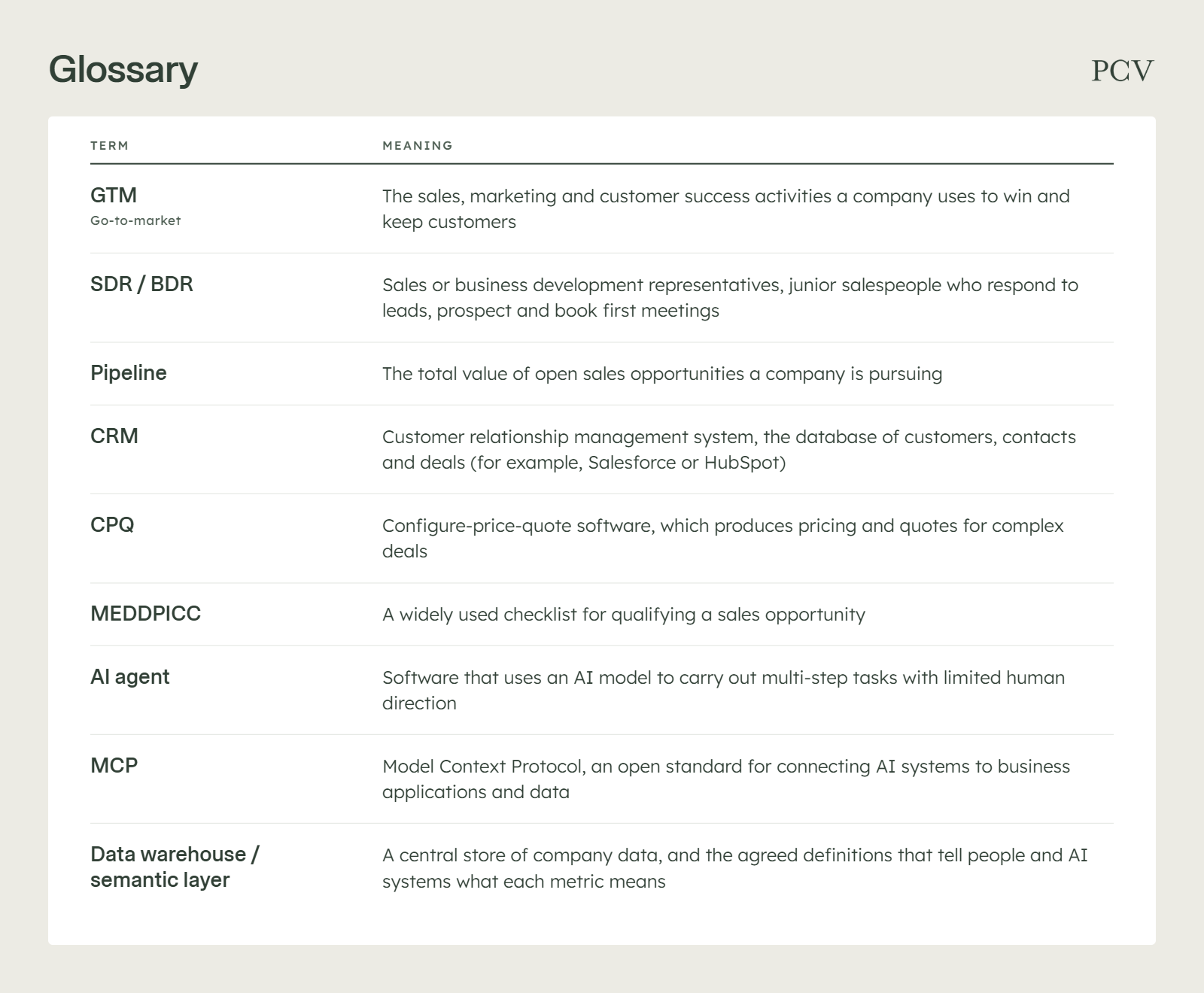
The tables below list every concrete build described in the roundtables, grouped into nine functional categories. To preserve the confidentiality of the sessions, names and companies are omitted. Each build is labeled by company type according to the attendee's breakout group: groups one through three comprised large enterprises, groups four through six mid-size companies, and groups seven and eight startups. Where an attendee described work at a previous employer, or a build observed at a client, the label says so. A short glossary of terms follows.
To help readers compare the categories, we scored each on four dimensions. The scores reflect our judgment based on what participants described, not measured data, and individual companies will differ.
Priority: whether the capability is a must have, a should have or a nice to have for most companies today.
AI autonomy: how much of the work AI performs, from human-led (people do the work, with AI assisting), to human in the loop (AI drafts, people approve), to autonomous (AI acts on its own while people oversee).
Cost and time: the money, effort and expertise typically required to build and maintain the capability (low, medium or high).
GTM impact: the relative effect on the performance of the go-to-market organization (low, medium or high).
Read together, the scores suggest a sequence. The must haves are the foundations (data, CRM capture and the operating model) together with the top of the funnel, where AI already acts on its own and the payoff is easiest to measure. Forecasting, analytics and support follow once the foundations are in place. Deal desk and conversation intelligence matter most where pricing is complex or where mature vendor tools fall short.
Pipeline and Top of Funnel
Responding to inbound demand, scoring leads and making first contact are the activities most fully delegated to AI. In at least two companies, the team that runs these agents now carries a pipeline target of its own. Results to date suggest that AI performs about as well as people at first contact; the open question is whether it can do better, particularly in outbound prospecting.

Deal desk
Configure-price-quote software was among the most criticized systems in the room. It is being challenged from two directions: lightweight applications built by individual operators at startups, and newer AI-native vendors working closely with larger customers. The most striking result in this category came from process rather than software. A company that standardized its contracts reduced its sales operations team by roughly three quarters while its renewal rate rose by 30 percentage points.

Revenue Planning
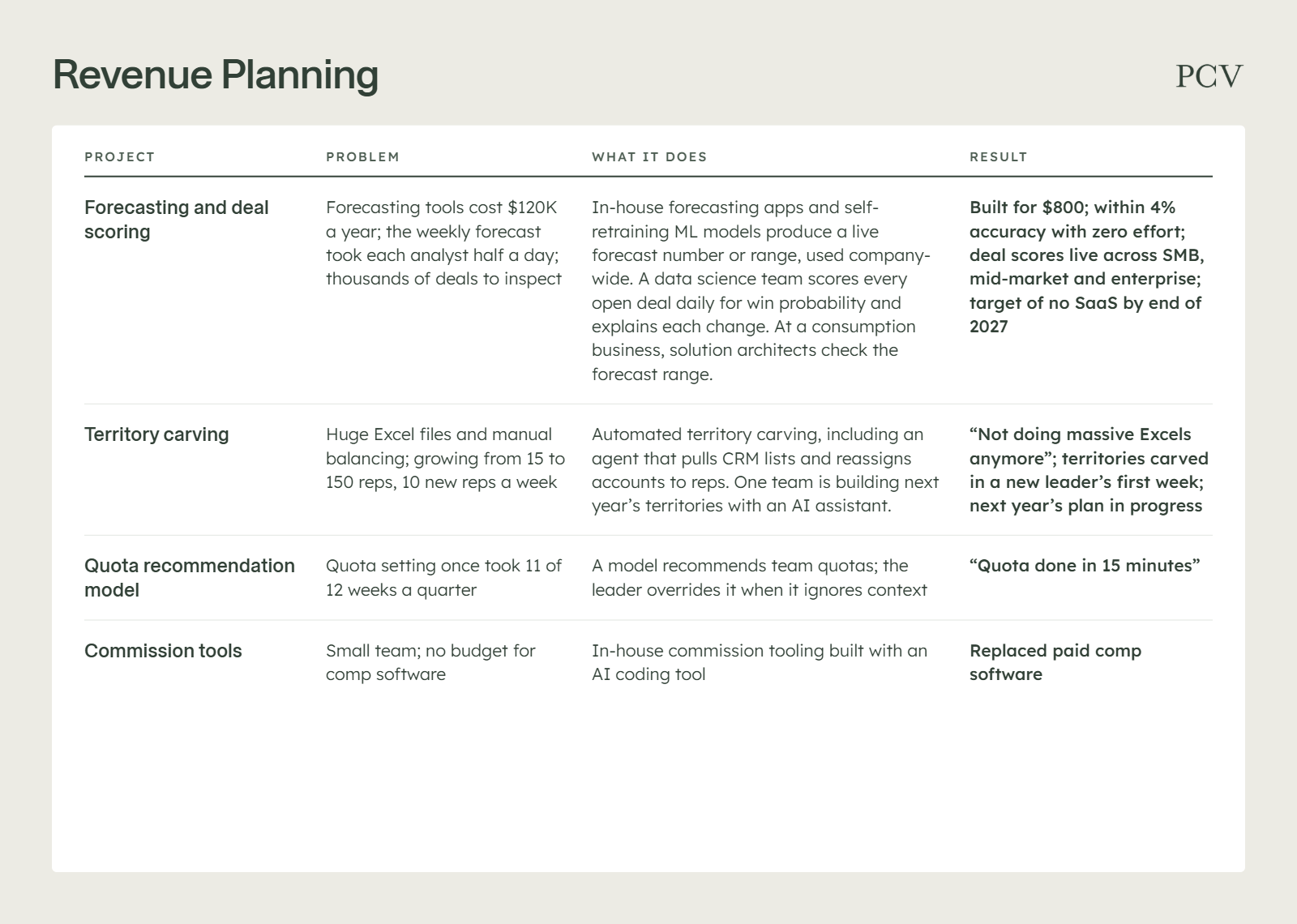
Forecasting, planning, territory design and quota setting have long been the core of the RevOps function, and they are now among its most automated activities. Large enterprises described self-retraining forecasts, real-time deal scoring and quota recommendation models, while mid-size companies are building internal replacements for planning software they had purchased but never fully implemented. What remains for people is judgment: deciding when to override a model, and using forecast reviews to hold teams accountable rather than to calculate the number.
Self-Serve Analytics
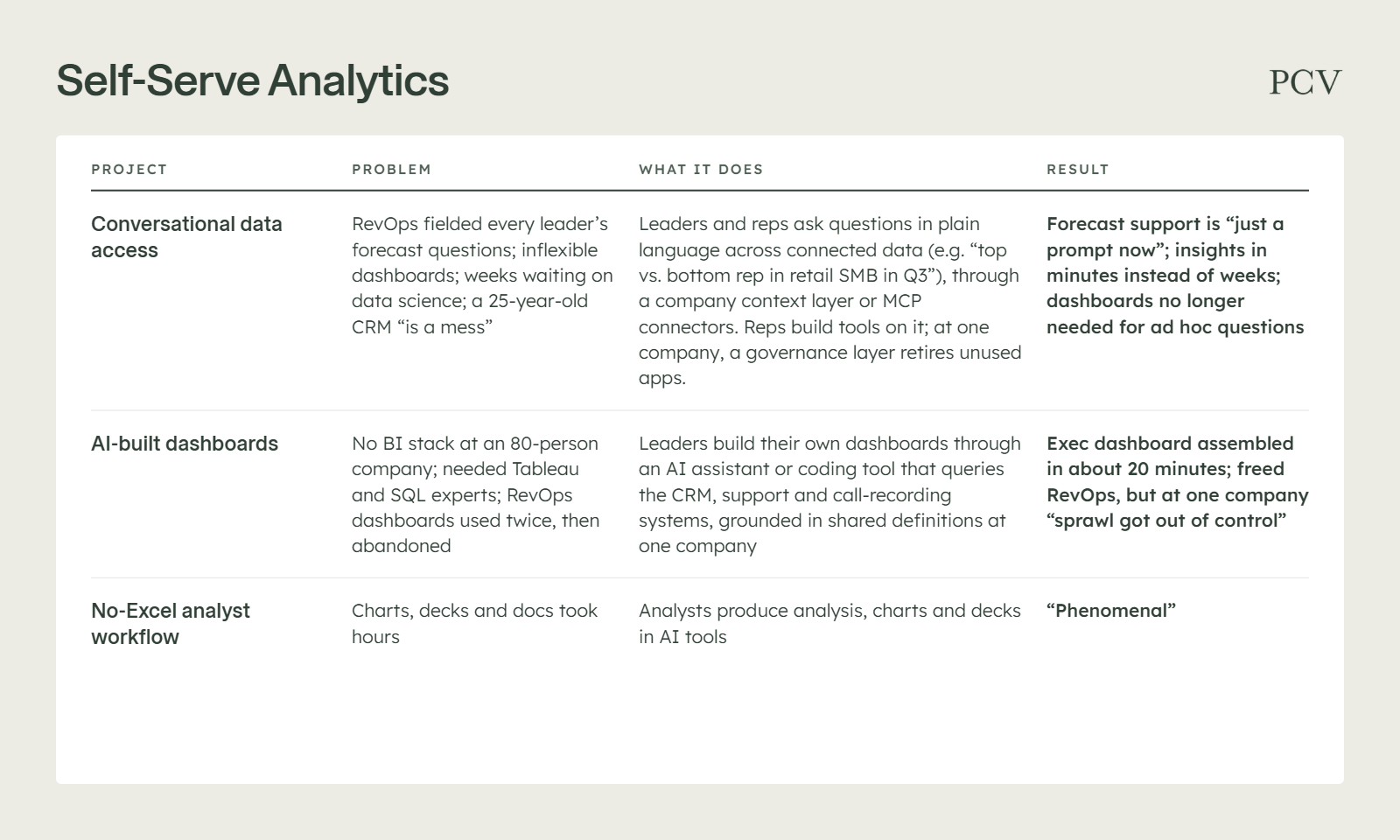
The traditional queue of requests for reports and dashboards is giving way to self-service. Executives increasingly put questions in plain language to systems connected to company data and receive answers in minutes. The cost of this convenience is consistency: several leaders described executives arriving at meetings with conflicting figures they had generated independently, a problem one attendee called "insight sprawl."
CRM
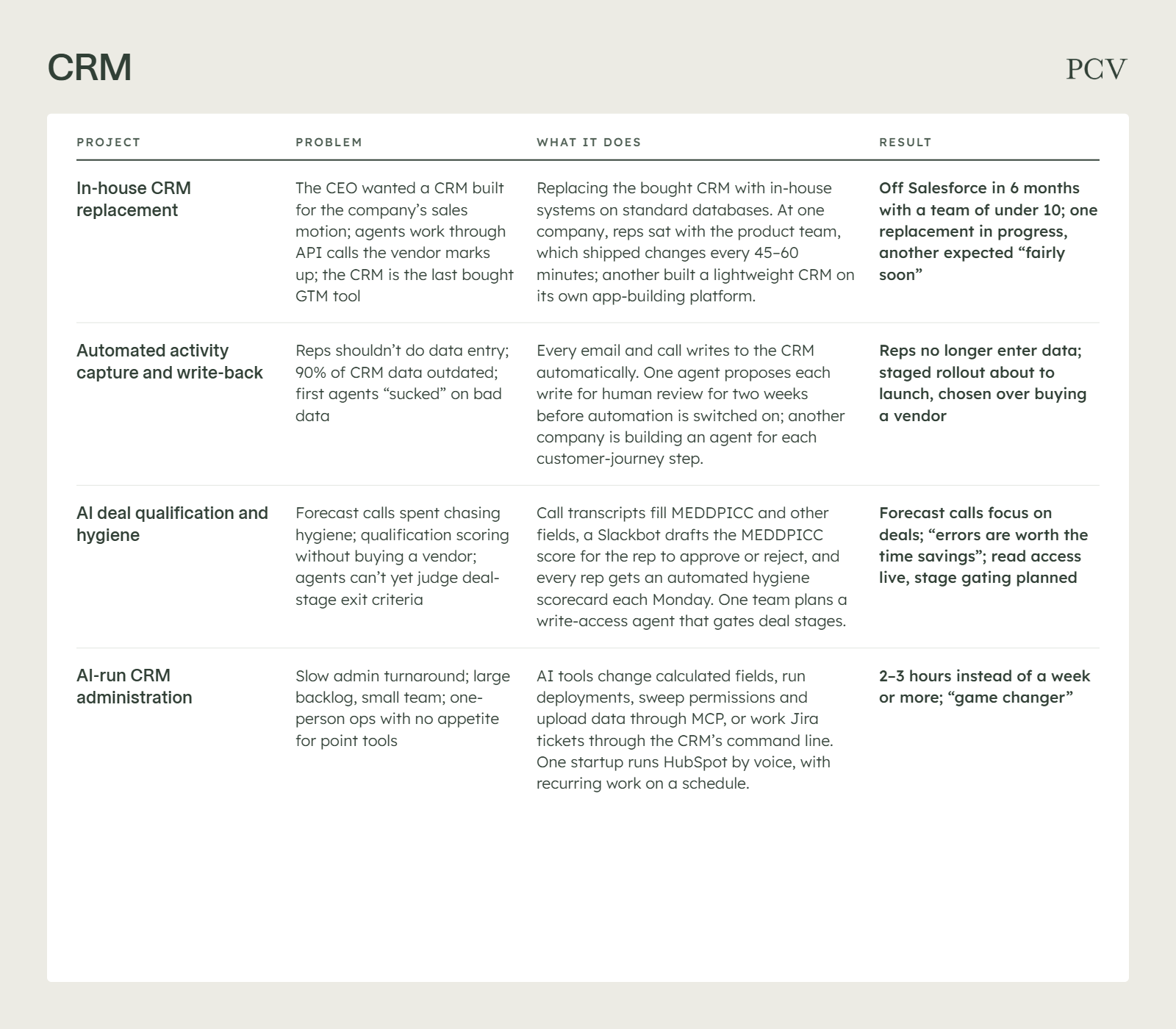
Two changes are under way in the CRM. First, salespeople are being removed from data entry, as call transcripts and email activity are written to the system automatically. Second, administration of the CRM is itself being done by AI, reducing changes that once took an administrator a week to a few hours. At the furthest end, three large enterprises are replacing the CRM altogether.
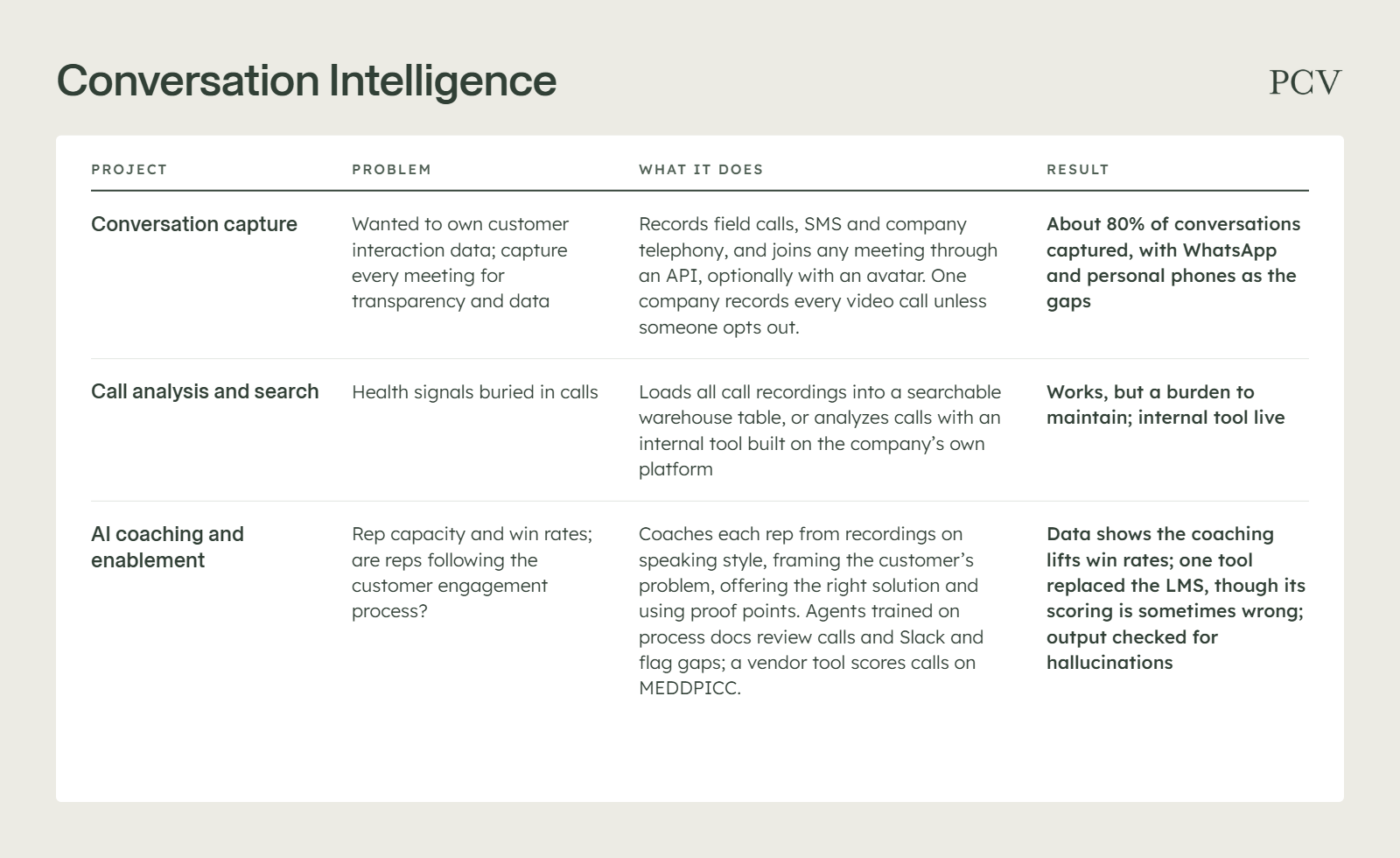
Conversation Intelligence
Companies increasingly want to own the record of their customer conversations. Several now record every meeting by default and use the recordings for coaching, deal review and early warning about customer health. The cautionary note from this group is that automated insight has value only if people act on it; one company found that its salespeople did not read the AI-generated briefing notes prepared for their customer meetings.
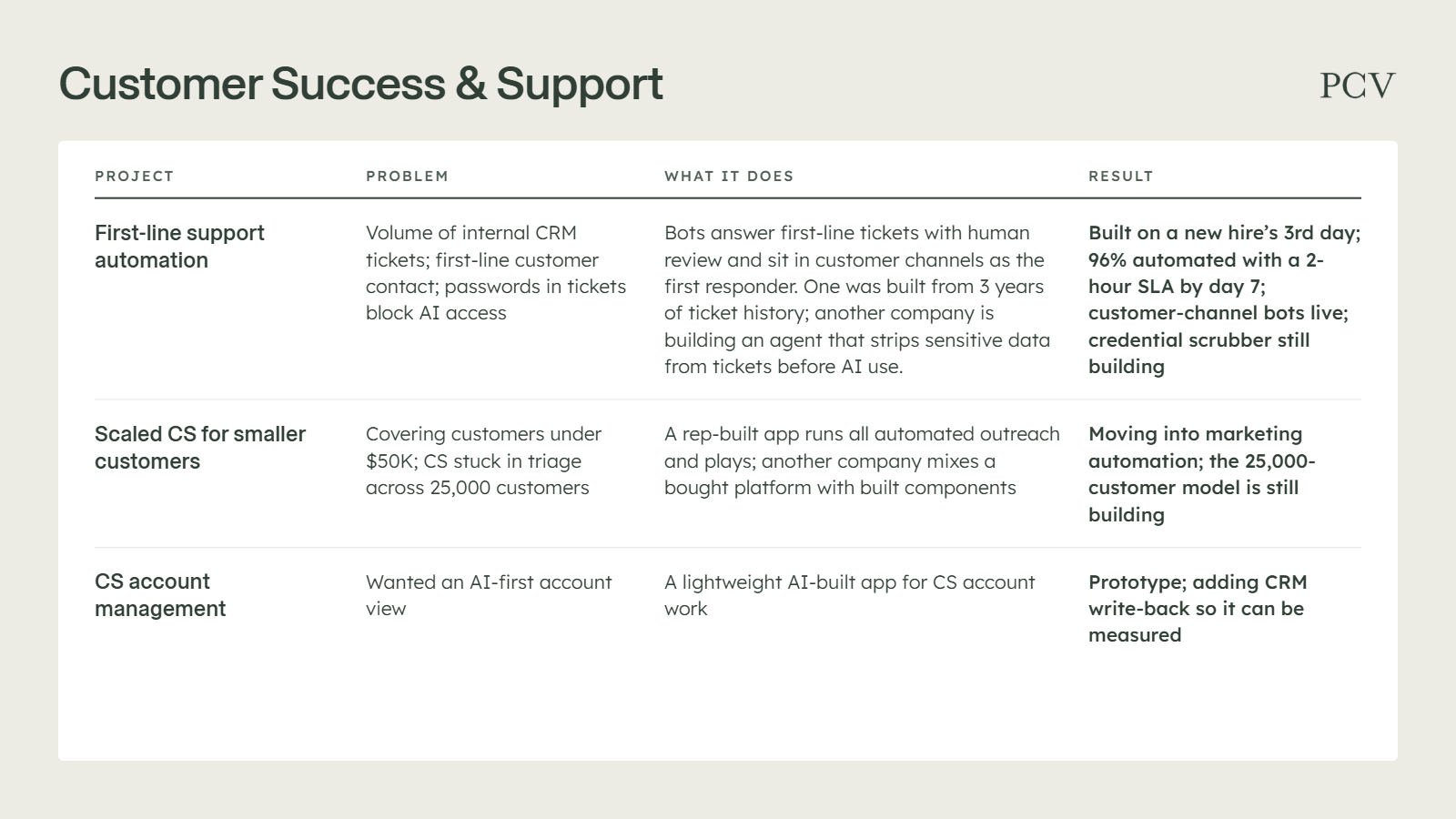
Customer Success & Support
Customer support proved more predictable, and therefore more automatable, than many expected. The most striking single result of the day came from this category: a newly hired operator used three years of historical tickets to automate 96% of a company's internal support requests within a week. Scaled customer success, in which small teams serve large numbers of smaller customers, is the other area of active building.
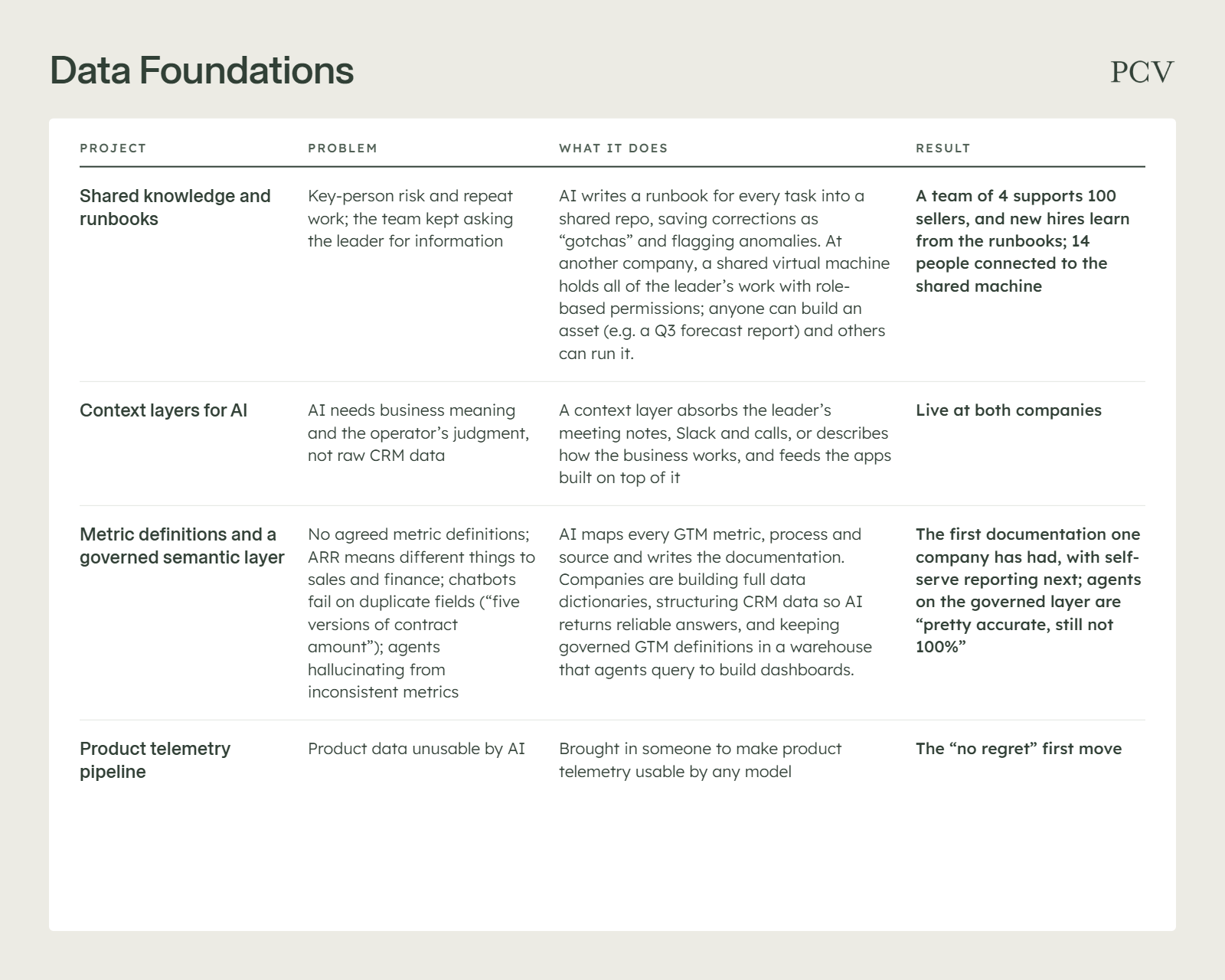
Data Foundations
The work in this category is the least visible and arguably the most important. Leaders are codifying how their businesses operate, through data dictionaries, governed metric definitions, documentation and step-by-step runbooks, so that AI systems have a reliable foundation to work from. Most of the successes described elsewhere in this article rest on work of this kind.
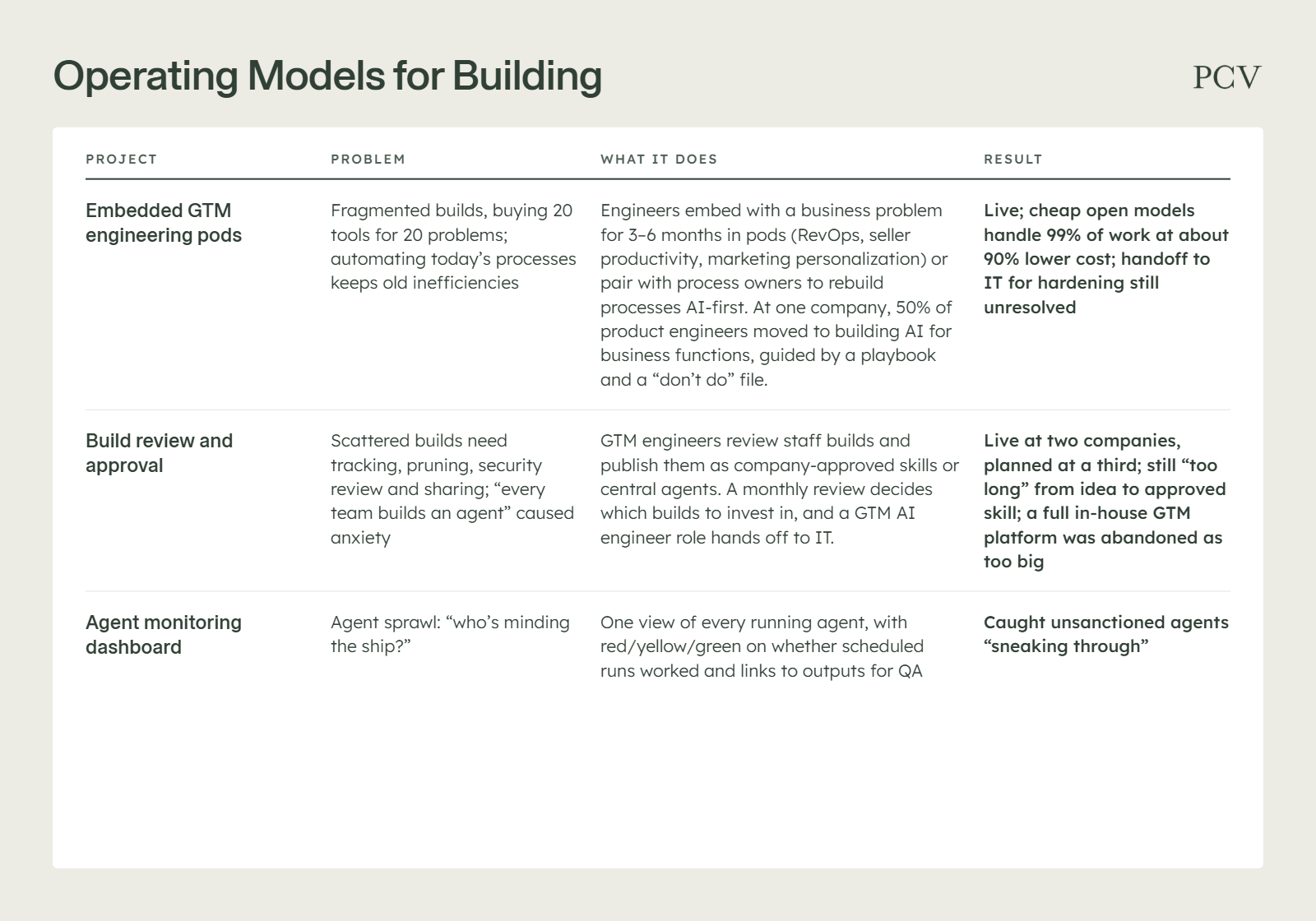
Operating Models for Building
Every company represented has had to decide who may build, who approves what is built, and who maintains it afterward. Approaches range from dedicated teams of engineers embedded in business functions to monthly reviews of which internal tools merit continued investment. The failures in this category are as instructive as the successes: mandates issued without a clearly defined problem, and hiring policies that produced thousands of unmanaged agents.
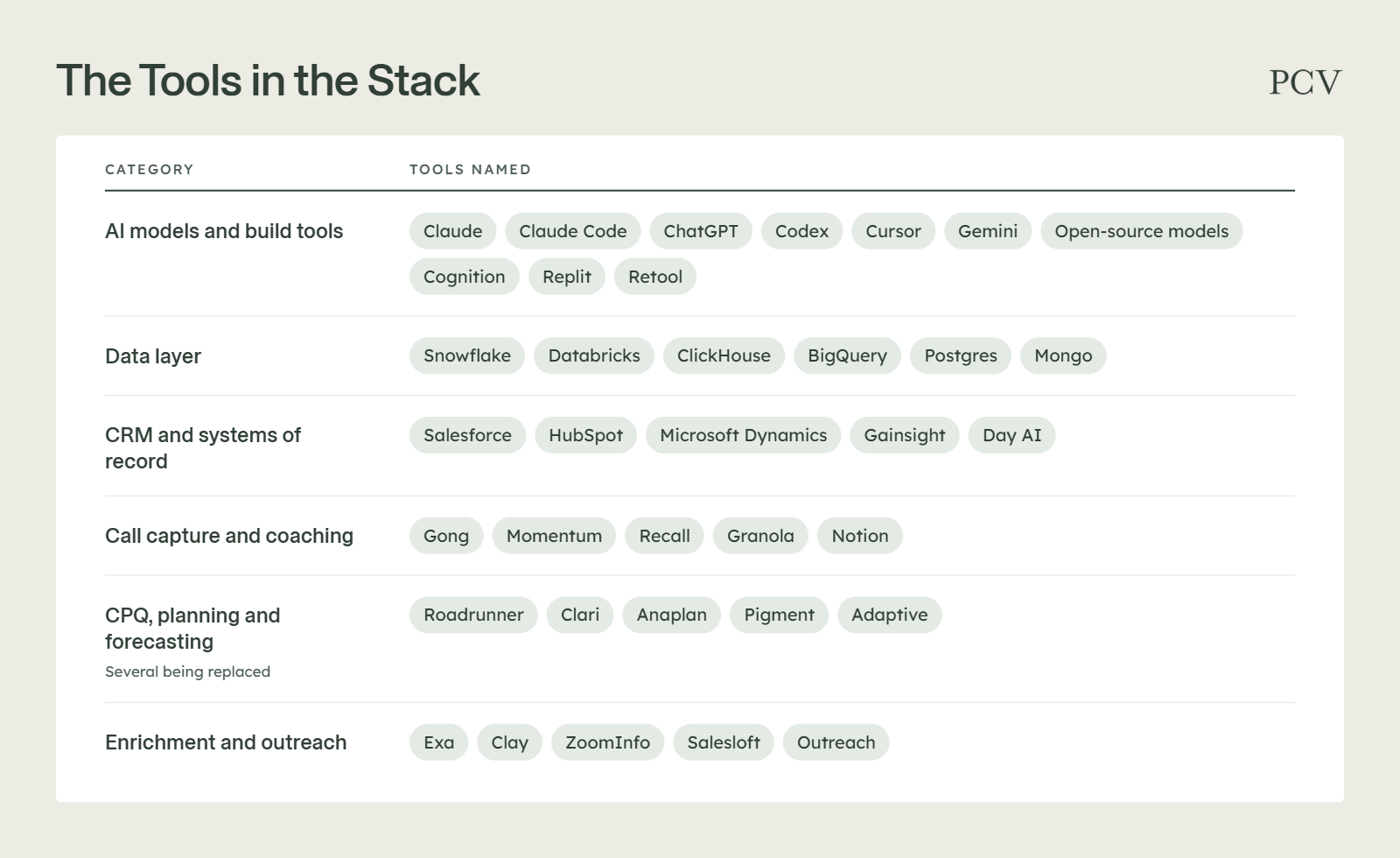
The Tools in the Stack
AI coding assistants and chat tools connected to company data through MCP were the most common foundation for these builds, appearing in at least six of the eight sessions. Beneath them, the data warehouse is increasingly serving as the true system of record.
Conclusion
Vector confirmed what many of us suspected: the commercial operations of technology companies are being rebuilt in real time, and the people doing that work are learning as quickly as the tools are changing. What struck us most was not any single build but the candor with which leaders shared both their results and their mistakes. We are grateful to every participant, and we intend to keep convening this community and reporting on what we learn.